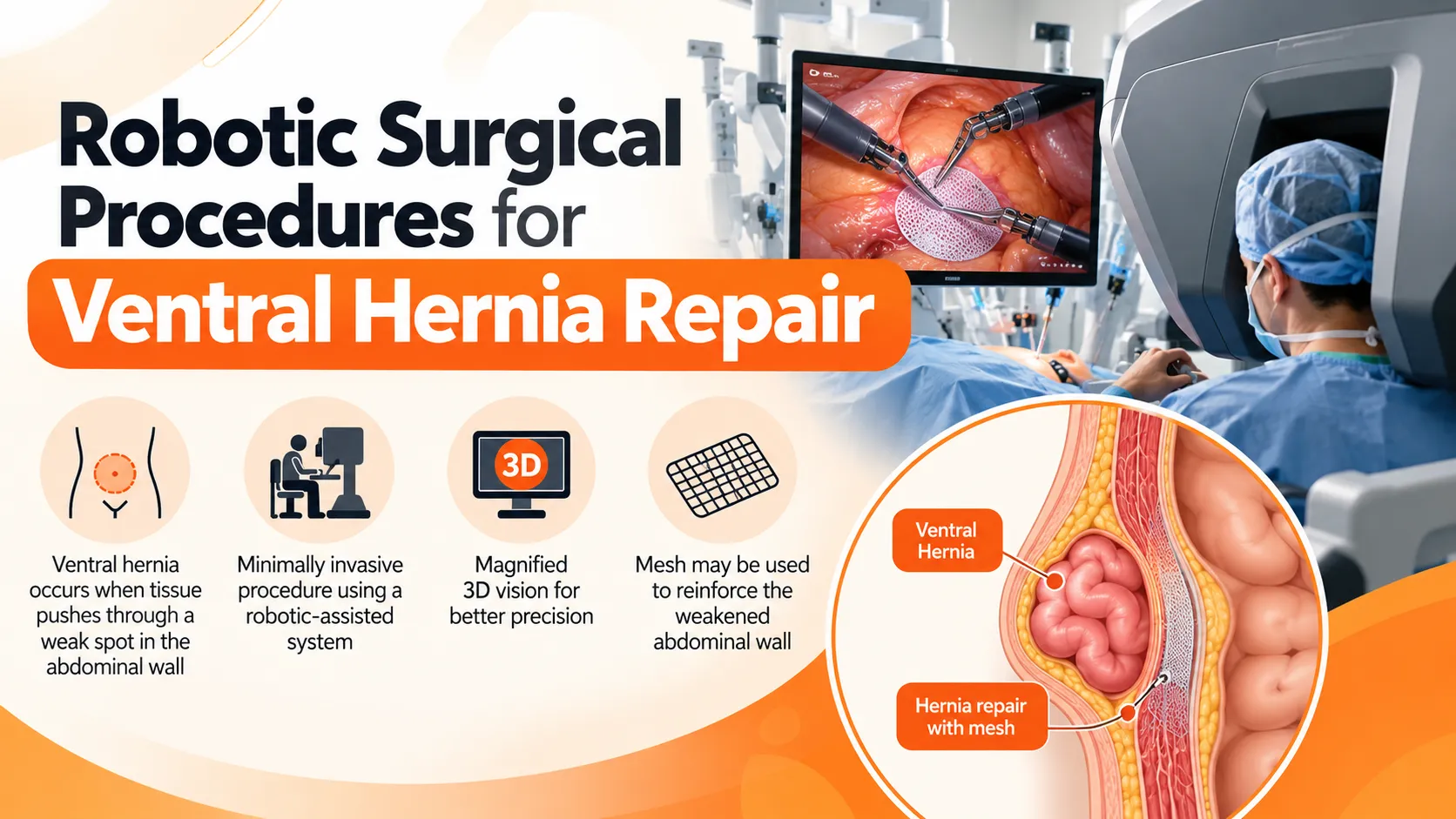
A ventral hernia occurs when tissue pushes through a weakened area of the abdominal wall, often near the navel or at the site of a previous surgical incision. Robotic ventral hernia repair is a minimally invasive procedure in which the surgeon uses a robotic-assisted system to repair the defect through small incisions. The system provides magnified 3D visualization and flexible instruments to assist with precise tissue dissection and suturing. Surgical mesh may be placed to reinforce the weakened abdominal wall when appropriate. The choice of robotic technique depends on the hernia’s size, location, complexity, and the patient’s medical history.
What Is Robotic Ventral Hernia Repair?
A robotic ventral hernia repair involves making several small cuts rather than a single large cut in the abdominal wall. The surgeon uses a camera to see the hernia, while the robot allows the surgeon to control their movements inside the abdomen.
In the course of the procedure, the protruding contents are returned to their normal place, and the defect is closed. Robotic hernia repair using a mesh is sometimes employed to reinforce the weakened area of the abdominal wall.
However, a mesh cannot be merely applied to the outside of the hernia. In many modern operations, the mesh can be implanted between the layers of the abdominal wall.
Robotic Techniques Used for Ventral Hernia Repair
The term robotic ventral hernia repair covers several surgical approaches. They are not interchangeable. The surgeon chooses the technique after looking at the hernia defect, abdominal wall muscles, and previous surgeries.
1. Robotic TAPP Repair
Robotic TAPP, or transabdominal preperitoneal repair, involves entering the abdominal cavity and creating a space between the abdominal wall and the peritoneum.
The mesh is placed in this space rather than directly against the bowel. The covering layer is then closed over the mesh.
This approach may be used for selected smaller or medium-sized ventral hernias, depending on their location and the patient's abdominal wall anatomy.
2. Robotic TARM or TARUP
Robotic TARM, also called transabdominal retromuscular repair, places the mesh in the retromuscular space behind the abdominal muscles.
The surgeon works through the abdominal cavity to reach this layer and carefully separates the tissues to create enough room for the mesh.
This technique can be useful when the defect needs stronger abdominal wall reinforcement, particularly in some larger midline or incisional hernias.
3. Robotic eTEP Repair
Robotic eTEP stands for extended totally extraperitoneal repair. Unlike techniques that enter the main abdominal cavity, the surgeon creates a working space outside the peritoneal cavity.
The retromuscular space is developed, the hernia defect is closed, and the mesh is placed within this space.
For selected ventral and incisional hernias, eTEP can provide a way to repair the abdominal wall while keeping the mesh away from the abdominal organs.
4. Robotic TAR
Robotic TAR, or transversus abdominis release, is a more advanced abdominal wall reconstruction technique.
It is generally considered when a large or complex hernia cannot be closed comfortably without putting too much tension on the abdominal wall. The surgeon releases a deeper muscle layer to create additional space and movement.
This allows a large piece of mesh to be placed in the retromuscular plane while helping bring the separated sides of the abdominal wall back together.
Why Is Mesh Used in Robotic Ventral Hernia Repair?
However, the abdominal wall should have enough strength to cope with the pressure from the act of coughing, lifting, movement, and everyday activities. Closing a larger hole where the hernia has occurred can subject the mended area to too much strain.
This is the reason why robotic ventral hernia repair with mesh is often recommended in cases of ventral hernia.
The mesh will be a form of reinforcement. Its placement is also important. Using one of the newer forms of robotic surgery, doctors try to place the mesh outside the abdominal cavity and between the layers of the abdominal wall.
The use of mesh does not mean that the hernia will not recur at all times.
How Does a Surgeon Choose the Robotic Technique?
A small umbilical hernia does not require the same operation as a large incisional hernia that developed after several previous surgeries.
Before choosing the procedure, the surgeon may assess:
- Size and position of the hernia
- Whether it is an umbilical, incisional, or another type of ventral hernia
- Previous abdominal operations
- Any earlier mesh repair
- Condition of the abdominal wall muscles
- Rectus muscle separation
- Obesity and other health conditions
- Previous hernia repairs and recurrence
- Whether the hernia can be closed without excessive tension
For larger, recurrent or complicated hernias, a CT scan may provide useful information about the abdominal wall and the exact size and location of the defect.
The choice of technique is therefore made around the patient's anatomy rather than simply choosing a robotic operation by name.
What Happens During Robotic Hernia Surgery?
General anesthesia is administered. Small incisions are created within the abdomen for the introduction of the camera and robotic equipment.
The hernia is initially inspected, and the tissue is returned into the abdomen. Then, surrounding tissues are separated to create the working area.
In accordance with the applied method, the hole of the hernia may be sutured. The mesh is then placed in the specified layer of the abdominal wall.
After the completion of the procedure, the equipment is withdrawn, and the small incisions are closed.
The duration of the procedure depends on the type of repair. Thus, the simple repair may take much less time than the complicated recurrent hernia reconstruction.
Recovery After Robotic Ventral Hernia Repair
However, recovery becomes more convenient in cases where the procedure can be performed via small cuts; regardless of that, the duration of the recovery process depends largely on the nature of the repair.
Some patients with a smaller hernia can be released immediately or within a few days. For larger repair cases, more monitoring may be required.
In the first days, there may be soreness in the area of the surgery. In most cases, walking is recommended right away, while lifting and strenuous activities are limited during some period of time recommended by the doctor.
One has to watch for any redness, swelling, fever, and unusual drainage from the wound.
The return to normal life occurs gradually. If a person undergoes complicated abdominal wall reconstruction, he may need more time than someone who has a small repair.
Possible Side Effects and Complications
Robotic surgery reduces the size of the skin incisions, but it does not remove the usual risks of hernia surgery.
Possible complications include:
- Pain or discomfort around the repair
- Bleeding
- Seroma or fluid collection
- Wound infection
- Mesh infection
- Injury to nearby organs or bowel
- Blood clots
- Difficulty passing urine in some patients
- Chronic pain
- Hernia recurrence
A temporary swelling or fluid collection can sometimes appear around the repaired area. Not every swelling means that the hernia has returned.
Robotic vs Open Ventral Hernia Repair
Open surgery involves making a bigger incision over the site of the hernia, while robotic repair involves making smaller incisions and using a surgical procedure guided by a camera.
Robotic surgery enables a reduction in the size of the abdominal incisions and might assist with healing and recuperation in selected cases. This procedure will offer the surgeon magnified 3D images and enable the surgeon to make small movements during surgery through the deeper tissue planes.
The use of open surgery remains relevant in cases of very large, complicated, or emergency hernias in certain patients who are not candidates for minimally invasive procedures.
It is important to note that the selection of a technique is determined by the type of hernia and the patient's overall medical condition.
Robotic Hernia Repair With Mesh: What Patients Should Know
Robotic surgery does not necessarily mean fast or easy surgery. Abdominal wall repairs may be complex procedures that involve extensive dissections, muscle repair, and placement of the mesh.
In essence, the robotic platform provides surgeons with more control and visualization. The relevance of this platform is especially clear when it comes to a procedure that needs to be done in a very tight area or involves advanced abdominal wall reconstruction.
For those interested in finding out what robotic hernia surgery means, the most basic definition is this: it is a minimally invasive procedure during which a surgeon repairs a hernia using robotic instruments and sometimes places mesh in the abdominal wall.
Conclusion
Robotic ventral hernia repair offers a minimally invasive option for treating selected abdominal wall defects, including ventral and incisional hernias. Techniques such as r-TAPP, r-TARM, eTEP, and robotic TAR may be considered depending on the size, location, and complexity of the hernia. However, the most suitable approach depends on the patient's anatomy, medical history, and overall health. Dr. Ajay Yadav, Gastro Surgeon in Lucknow, has more than 23 years of surgical experience and provides laparoscopic and robotic-assisted surgical care for suitable patients. A detailed consultation can help determine the appropriate treatment approach based on individual needs.
FAQs
Robotic ventral hernia repair: Is it safe?
Robotic ventral hernia repair is one of the minimally invasive procedures available for select patients. There are risks associated with all surgeries, such as bleeding, infection, seroma, bowel injury, and recurrence.
Robotic ventral hernia repair: Is mesh always necessary?
Not always. Mesh is often used in ventral hernia repair, especially if the surgeon wishes to reinforce the abdominal wall further, but it depends on the size and type of hernia to be repaired.
What is the operative time in robotic ventral hernia repair?
Operative time is variable. It takes much shorter time to repair a small, uncomplicated ventral hernia, whereas a big and complicated one may require longer surgery.
Is there a risk of recurrence of a ventral hernia following robotic surgery?
Yes, there is. Recurrence cannot be ruled out by performing robotic surgery since a lot of variables, including hernia size, weakness of the tissues, obesity, smoking, diabetes, wound issues, among others, can influence the outcome.
When can you return to your usual activities following a robotic hernia repair procedure?
The patient is encouraged to do some light activity but should avoid strenuous activities and lifting.
Related Blogs
- Robotic Hernia Surgery: How It’s Done, Recovery & Side Effects
- Robotic Hernia Surgery Cost in India
- Robotic vs Laparoscopic Hernia Surgery: Which Is Better?
- What Is the Difference Between Sleeve Gastrectomy and Gastric Bypass?